
Why Canadian Businesses Need a Bilingual LMS with Multilingual Support for Effective Training
Bilingual learning management systems (LMS) are specialized e-learning platforms that deliver training in multiple languages and ensure employees receive instruction in their preferred official language. For Canadian businesses, a bilingual LMS addresses regulatory requirements, improves comprehension across diverse teams, and reduces operational risk when safety or compliance training is required in both English and French. This article explains why bilingual training matters in Canada, maps language laws to concrete LMS features, and outlines how platforms like Totara and Moodle support bilingual employee development and localized training content. You will learn practical benefits, measurable KPIs, platform comparisons, implementation best practices, and emerging trends such as AI-assisted translation and adaptive multilingual learning. Read on for a Canada-first, compliance-focused guide to selecting and deploying a multilingual training platform that preserves certification, streamlines onboarding, and scales enterprise learning across provinces and languages.
What Is the Importance of Bilingual Training for Canadian Businesses?
Bilingual training matters because it reduces misunderstandings, strengthens legal compliance, and unlocks market access in francophone regions; the mechanism is delivering equivalent training assets and assessments in English and French so learners gain the same competency regardless of language. Providing bilingual training increases employee inclusion and lowers error rates in regulated tasks by ensuring comprehension and cultural relevance. Employers that invest in multilingual training platforms demonstrate operational maturity and prepare for audits by maintaining versioned records and language-specific completion data. The next section explains how bilingual training directly improves engagement and retention through measurable behavioral and performance outcomes.
How Does Bilingual Training Improve Employee Engagement and Retention?
Bilingual training improves engagement by offering instruction in an employee’s preferred language, which increases comprehension, confidence, and perceived organizational support. When learners understand expectations and assessments, time-to-productivity shortens and certification pass rates rise, producing measurable retention gains. Psychologically, language-appropriate training fosters inclusion and reduces cognitive load, which correlates with fewer workplace errors and higher job satisfaction. These learning outcomes feed directly into improved operational performance and lower voluntary turnover, which in turn supports scalable talent development across bilingual regions.
Why Is Multilingual Support Essential for Overcoming Language Barriers in Canada?

Multilingual support eliminates barriers by providing translated interfaces, subtitles, and language-routing so that learners automatically receive content aligned to their preferences and regulatory needs. Features such as auto-language selection, multilingual assessments, and translated feedback reduce misunderstandings in safety-critical or compliance-heavy content. Accessibility improves for remote and distributed teams when courseware, transcripts, and assessments are available in both official languages, which supports consistent performance measurement across provinces. These capabilities form the foundation for mapping legal obligations to LMS functionality, discussed in the following section.
How Do Canadian Language Laws Impact Corporate Training Requirements?
Canadian language laws create explicit obligations for federal institutions and for businesses operating in francophone jurisdictions; the mechanism is legal expectation that certain communications and training be available in both official languages or in French-first formats for specified employers. Organizations must translate HR and safety materials, maintain bilingual delivery options, and keep auditable records that show equivalent training was issued and completed. LMS capabilities such as version control, bilingual delivery rules, and compliance reporting are practical responses that satisfy record-keeping and audit-readiness needs. The next subsections map these statutory obligations to concrete LMS actions and configuration strategies.
What Are the Key Training Obligations Under the Official Languages Act?
The Official Languages Act requires federal institutions and certain federally regulated employers to provide services and communications in both official languages; in practice this means training materials and HR documentation must be available in English and French where the law applies. From a training perspective, organizations should preserve bilingual course versions, track which language was delivered, and retain completion records for audits and monitoring. LMS functions that support these obligations include language-specific course catalogs, downloadable bilingual certificates, and compliance dashboards that surface language-based completion metrics. These system features reduce legal risk by providing transparent evidence of equal-language training delivery.
LMS Compliance Strategies for Educational Technology
Strategic analysis may also help establish policies and goals for the development and implementation of a Learning Management System (LMS) to ensure compliance with law and technical requirements.
Applying Internet Laws and Regulations to Educational Technology, BL Mann, 2020
| Obligation | LMS Capability | Practical Implication |
|---|---|---|
| Bilingual availability of materials | Multilingual content storage and delivery | Employees can access HR and safety courses in their official language |
| Record-keeping and auditability | Version control and audit trails | Administrators can produce evidence of when and in what language training was delivered |
| Monitoring and reporting | Compliance dashboards and language filters | Compliance teams can generate language-specific completion reports for regulators |
These mappings show how technical LMS features translate legal requirements into operational tasks that preserve compliance and learner equivalence.
How Does Quebec’s Bill 96 Affect LMS Use for French Language Compliance?
Quebec’s Bill 96 increases French-language expectations for businesses operating in the province by creating thresholds where French-first communications and services become mandatory; the practical effect on LMS use is a requirement for French-priority course catalogs and French-capable user interfaces. LMS deployments targeting Quebec should default to French for course enrollment prompts, notifications, and system messages while retaining English equivalents upon request. Administrators should also prepare bilingual audit trails and French-language certification workflows to satisfy provincial examiners. Implementing these changes often requires content-first localization and technical rules that map employee location and language preference to delivery logic.
Strengthening Official Languages Commissioner Powers in Canada
The Official Languages Act was our opportunity to strengthen the powers of the Commissioner of Official Languages. We must ensure that all federal institutions are complying with their official language obligations.
Strengthening the powers of the Commissioner of Official languages–Question Period Card, Minister of Official Languages and Minister responsible for the Atlantic …, 2022
| Legislation | Requirement | LMS Action |
|---|---|---|
| Bill 96 (Quebec) | French-first communications for qualifying businesses | Default UI and notifications to French; provide English opt-in |
| Regional thresholds | Language obligations triggered by employer size/scope | Configure delivery rules based on employee location and role |
| Audit expectations | Demonstrate French-language access and equivalency | Maintain bilingual certificates and language-specific completion logs |
These legal-driven configuration choices ensure LMS deployments meet provincial scrutiny and support francophone workforce inclusion.
What Are the Benefits of Using a Multilingual LMS for Canadian Businesses?
A multilingual LMS centralizes translation workflows, enforces consistent bilingual delivery, and provides compliance evidence through reporting and audit trails; this combination reduces legal exposure while improving learner outcomes. Key benefits include streamlined compliance, higher engagement and retention, and operational scalability through content reuse and role-based delivery. Below are measurable KPIs to monitor the impact of multilingual training investments and to align learning outcomes with business objectives.
How Does a Multilingual LMS Streamline Compliance and Reduce Risk?
A multilingual LMS streamlines compliance by centralizing translation assets, maintaining version history for each language, and logging delivery and assessment results as audit-ready records. This mechanism enables compliance teams to quickly produce evidence for regulators, to show that equivalent French and English courses were issued and completed. Example workflows include automated assignment of language-appropriate certifications after a training event and retention of side-by-side course versions for audit comparison. By automating language routing and reporting, organizations reduce manual errors and administrative overhead associated with bilingual compliance tasks.
| Benefit | Metric/KPI | Expected Impact |
|---|---|---|
| Compliance readiness | Time to produce audit report (hours) | Reduced from days to hours with bilingual reporting |
| Training equivalence | Percentage of learners completing courses in preferred language | Increased completion and certification parity across languages |
| Administrative efficiency | Hours saved per quarter on translation management | Lower operational costs from centralized translation workflows |
These KPIs help quantify compliance and operational gains, enabling learning leaders to justify multilingual LMS investments to stakeholders.
This site helps organizations streamline training, meet compliance, and scale learning with Totara and Moodle, offering expert-backed LMS solutions for onboarding, certification, and learner engagement. Embedding that mission into platform selection and implementation ensures the technical design directly supports compliance, learner experience, and measurable business outcomes.
In What Ways Does a Bilingual LMS Boost Productivity and Scalability?
A bilingual LMS boosts productivity by enabling content reuse across languages, standardizing role-based pathways, and automating enrollment so employees access required training immediately. Scalability is achieved when centrally managed translation memory and templated course structures reduce incremental localization effort for new modules. Measurable outcomes include reduced time-to-productivity for new hires in bilingual regions, fewer support queries about course interpretation, and faster rollout of mandatory certification programs across provinces. These operational efficiencies convert training investments into predictable performance improvements across diverse workforce segments.
The following list outlines operational efficiencies to expect:
- Faster Onboarding: Language-appropriate modules shorten ramp-up time for new hires.
- Lower Translation Costs: Reusable content and translation memory reduce per-course localization expense.
- Consistent Certification: Role-based bilingual pathways preserve assessment equivalency across languages.
These efficiencies create a scalable learning architecture that supports growing bilingual operations while controlling costs.
Why Choose Totara or Moodle for Bilingual Training in Canada?
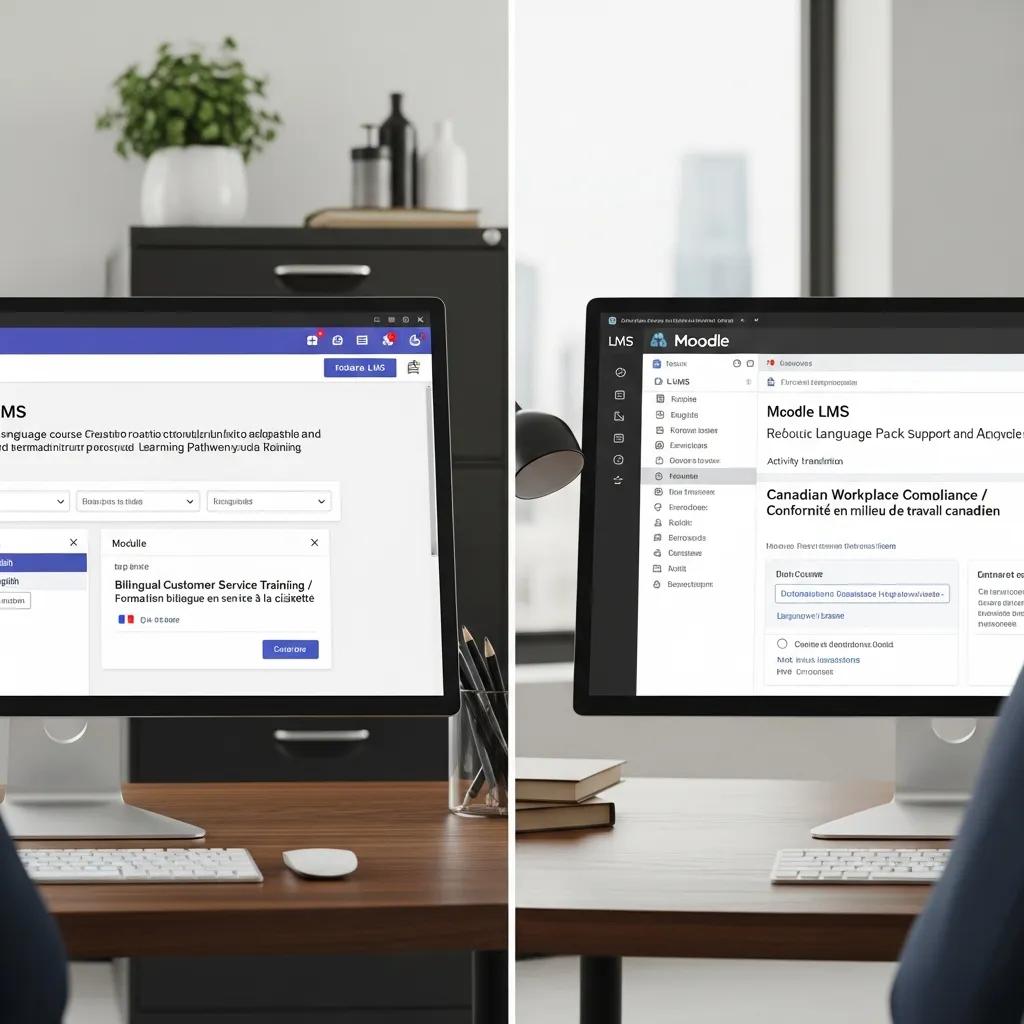
When evaluating platforms for Canadian bilingual training, consider enterprise features, reporting capabilities, and language support; both Totara and Moodle present suitable foundations but differ in configuration pathways and scalability models. Totara typically emphasizes enterprise compliance workflows, hierarchical user management, and rich reporting—features that map well to regulated organizations. Moodle provides open-source flexibility, broad language-pack support, and extensible localization workflows that suit organizations prioritizing customizability and cost-effective scaling. The next subsections compare specific platform attributes and show how they support bilingual compliance and content delivery.
This site helps organizations streamline training, meet compliance, and scale learning with Totara and Moodle, offering expert-backed LMS solutions for onboarding, certification, and learner engagement. Embedding this purpose clarifies vendor positioning when mapping platform strengths to legal and training needs.
What Features Make Totara Ideal for Canadian Bilingual Compliance?
Totara is designed for enterprise learning management with built-in compliance reporting, role-based learning plans, and hierarchical organizational structures; these features help map legal obligations to training workflows. The platform’s reporting engine supports language-segmented dashboards and exportable audit trails so compliance teams can filter completions by language, date, and region. Totara’s cohort and role management enable localized certification pathways where employees in francophone regions receive French-first assignments automatically. Administrators can configure approval workflows and certificate issuance that align with Official Languages Act and provincial requirements, which simplifies audit preparation and regulatory response.
| Platform | Feature | How it helps bilingual compliance in Canada |
|---|---|---|
| Totara | Advanced reporting | Language-segmented dashboards for audit evidence |
| Totara | Role-based learning plans | Automatic assignment of language-appropriate pathways |
| Totara | Hierarchical management | Scalable deployment across departments and provinces |
This table highlights Totara’s enterprise-oriented features that reduce friction for organizations with complex compliance needs.
How Does Moodle’s Flexibility Support Multilingual Corporate Training?
Moodle’s open-source ecosystem offers language packs, plugin-based translation workflows, and flexible content authoring that supports broad multilingual deployment with configurable localization. Administrators can enable auto-language selection, deploy translated course branches, and integrate translation memory tools to accelerate localization. While Moodle requires more configuration for enterprise-grade reporting, its customizable architecture allows teams to implement bilingual interfaces and assessments with lower initial licensing cost. For organizations that prioritize extensibility and community-driven language support, Moodle provides a practical path to deliver localized onboarding, certification, and learner engagement programs.
Key Moodle strengths for multilingual training:
- Language Packs: Native support for many languages and easy UI localization.
- Plugin Ecosystem: Extensible translation workflows and content authoring tools.
- Flexible Authoring: Content creators can publish parallel language versions with modular reuse.
These attributes make Moodle attractive for teams that value customization and modular localization.
How Can Canadian Businesses Successfully Implement a Bilingual LMS Strategy?
Successful bilingual LMS implementation follows a measured plan: define language policies, create a source-content strategy, configure technical delivery rules, and measure outcomes with language-aware KPIs. Integration planning should include SSO and provisioning, language preference mapping, and secure data flows for audit reporting. Change management and cultural adaptation are essential to ensure content resonates with francophone learners and that native reviewers validate translations. The next subsections provide practical localization best practices and integration considerations with Canadian HR systems.
What Are Best Practices for Content Localization and Cultural Adaptation?
Effective localization starts with a source-content strategy that separates translatable text from media and that uses translation memory and glossaries to ensure consistency; this reduces redundant translations and preserves technical terminology. Cultural adaptation involves replacing examples and imagery with regionally appropriate scenarios and having native reviewers perform QA to catch nuance and regulatory phrasing. A practical checklist includes building glossaries, establishing review cycles, and using a human-in-the-loop process for legal or safety-critical modules. These practices ensure translated modules are not merely literal conversions but are pedagogically equivalent and legally sound.
Localization checklist:
- Translation Memory: Reuse previous translations to cut costs and speed delivery.
- Glossary & Style Guide: Enforce consistent terminology across courses.
- Native QA Review: Validate tone, legal phrasing, and cultural references.
Applying this checklist improves translation quality and learner relevance while lowering long-term localization costs.
How Do You Integrate a Multilingual LMS with Canadian HR Systems?
Integration with HR systems focuses on provisioning, identity, and data flows so that an employee’s language preference, location, and role drive course assignment and reporting. Recommended integration points include SSO for seamless access, SCIM-style provisioning for user attributes, and data synchronization to populate completion records in HRIS for payroll or compliance purposes. Mapping tables should align HR attributes (location, language preference, job grade) with learning channels to ensure the LMS delivers the correct language version and certification pathway. Secure, auditable data flows enable compliance teams to generate language-specific reports during regulatory reviews.
| Integration Point | Recommended Action | Outcome |
|---|---|---|
| SSO & Provisioning | Map language preference attribute during provisioning | Automatic delivery of language-appropriate content |
| HRIS synchronization | Sync completion records to HR systems | Unified employee learning and compliance records |
| Audit logging | Capture language and version metadata | Audit-ready evidence for regulators |
These integration steps help maintain consistent language-based learning pathways and reliable compliance reporting.
What Are the Future Trends and Success Stories in Canadian Bilingual LMS Adoption?
Emerging trends include AI-assisted translation workflows, adaptive multilingual learning paths, and increased emphasis on measurable ROI for bilingual training investments; these developments accelerate localization while highlighting the need for human review on legal content. Organizations are piloting human-in-the-loop pipelines that combine machine translation for draft localization with native reviewer sign-off for certified materials. Success stories typically report faster course rollout in bilingual regions, improved certification rates, and demonstrable audit readiness; the following subsections explore AI translation limits and anonymized vignettes that illustrate measurable outcomes.
How Is AI-Powered Translation Enhancing Bilingual LMS Solutions in Canada?
AI-powered translation accelerates initial localization by producing draft translations and auto-subtitles that reduce turnaround time, enabling rapid iteration and broader content coverage. The mechanism is machine translation plus translation memory, followed by human post-editing to ensure legal precision and cultural accuracy, especially for compliance and safety content. For non-regulatory modules, AI can provide near-production-quality translations that improve learner access and experience, but human review remains mandatory for regulated materials. Balancing speed and legal accuracy yields efficient workflows that scale bilingual training without compromising compliance.
Practical AI translation workflow:
- Initial MT Draft: Generate a machine-translated version to speed delivery.
- Human Post-Edit: Native reviewer adjusts legal and cultural phrasing.
- Publish with Versioning: Maintain audit trail showing machine + human steps.
This hybrid approach reduces localization time while preserving quality for compliance-sensitive training.
Which Canadian Businesses Have Thrived Using Multilingual Training Platforms?
Anonymized vignettes show clear outcomes when bilingual LMS deployments focus on compliance, onboarding, and certification: one enterprise reduced onboarding time in bilingual regions by nearly 25% after adopting language-routing and role-based pathways, another reported a marked improvement in certification parity across languages, and a third accelerated regulatory audit responses by centralizing bilingual audit trails. Each success story follows a common pattern: define language policy, centralize translation and versioning, and instrument KPIs to measure time-to-certification and audit readiness. These measurable results demonstrate that multilingual e-learning platforms deliver both compliance assurance and operational ROI when implemented with clear governance.
Success factors across vignettes:
- Clear language governance: Policies that determine French-first or bilingual delivery.
- Centralized localization: Translation memory and native QA to ensure consistency.
- KPI tracking: Time-to-certification and audit-report latency as primary metrics.
This pattern provides a replicable template for organizations looking to achieve similar bilingual learning outcomes.
This site helps organizations streamline training, meet compliance, and scale learning with Totara and Moodle, offering expert-backed LMS solutions for onboarding, certification, and learner engagement.
Frequently Asked Questions
What are the key features to look for in a bilingual LMS?
When selecting a bilingual LMS, prioritize features such as multilingual content delivery, automated language selection, and compliance reporting capabilities. Look for systems that support version control to track training materials in both languages, as well as user-friendly interfaces that allow learners to switch languages easily. Additionally, consider platforms that offer robust analytics to measure engagement and completion rates across different language groups, ensuring that all employees receive equivalent training experiences.
How can businesses measure the effectiveness of bilingual training programs?
To measure the effectiveness of bilingual training programs, businesses should track key performance indicators (KPIs) such as completion rates, certification pass rates, and employee engagement levels. Surveys and feedback forms can also provide qualitative insights into learner satisfaction and comprehension. Additionally, comparing performance metrics before and after implementing bilingual training can help assess its impact on productivity and compliance, allowing organizations to make data-driven decisions for future training initiatives.
What challenges might organizations face when implementing a bilingual LMS?
Organizations may encounter several challenges when implementing a bilingual LMS, including resistance to change from employees, the complexity of translating existing content, and ensuring compliance with language laws. Additionally, technical issues related to system integration and user interface customization can arise. To mitigate these challenges, businesses should invest in change management strategies, provide adequate training for staff, and engage native speakers for quality assurance in translations to ensure cultural relevance and accuracy.
How does a bilingual LMS support compliance with Canadian language laws?
A bilingual LMS supports compliance with Canadian language laws by ensuring that all training materials and communications are available in both official languages, English and French. It provides features like version control and audit trails to document language-specific training delivery. By maintaining records of which language was used for training, organizations can demonstrate compliance during audits and ensure that they meet legal obligations, particularly in federally regulated sectors and regions with significant francophone populations.
What role does cultural adaptation play in bilingual training?
Cultural adaptation is crucial in bilingual training as it ensures that content is not only translated but also resonates with the target audience. This involves modifying examples, imagery, and scenarios to reflect the cultural context of learners. Effective cultural adaptation enhances engagement and comprehension, making training more relevant and effective. Organizations should involve native speakers in the localization process to validate that the training materials are culturally appropriate and legally compliant, particularly for sensitive topics like safety and compliance.
Can a bilingual LMS be integrated with existing HR systems?
Yes, a bilingual LMS can be integrated with existing HR systems to streamline user management and reporting. Integration points typically include single sign-on (SSO) for seamless access, data synchronization for tracking training completions, and mapping employee attributes like language preference and location. This ensures that employees receive the appropriate language version of training materials and that their progress is accurately reflected in HR records, facilitating compliance and operational efficiency across the organization.
Ready to Deploy a Bilingual LMS in Your Organization?
If you are operating in Canada and need a training platform that truly supports English and French, Markanyx can help you design, configure, and support a bilingual Totara or Moodle LMS aligned with your compliance and operational goals. From language routing and localization workflows to audit-ready reporting, our team works with you to build a solution that fits your reality.
Book a free demo with Markanyx today to see how a bilingual LMS can streamline your compliance, onboarding, and certification programs.