

Microlearning in the Flow of Work: Leveraging Your LMS for Effective Bite-Sized Training
Microlearning delivers focused, bite-sized learning experiences, typically three to ten minutes long—designed to meet single learning objectives at the point of need. This article explains how microlearning supports Learning in the Flow of Work (LIFOW), the LMS capabilities required to scale it, and practical design and measurement strategies that L&D teams can implement right away. Readers will learn the defining characteristics of microlearning, evidence-backed benefits for retention and compliance, stepwise implementation guidance, and concrete KPIs to prove ROI. We’ll also map essential LMS features to real workplace triggers and explore Totara and Moodle platform strengths where relevant. By the end, you will have a strategic blueprint for embedding microlearning into daily workflows and measuring its impact across onboarding, certification, and performance outcomes.
What Is Microlearning and How Does It Enhance Learning in the Flow of Work?
Microlearning is short, focused instruction that delivers a single learning objective in a compact format, enabling immediate application at the point of need. It works by reducing cognitive load, enabling spaced repetition, and allowing quick retrieval practice that aligns with on-the-job moments. Delivering content during workflows increases relevance and uptake, so learners apply new knowledge immediately and reinforce it through repeated micro-interactions. The result is faster skill acquisition and reduced time-to-competency, which supports continuous performance improvement across roles.
What Defines Microlearning and Its Key Characteristics?
Microlearning focuses on one clear objective, brief duration, and immediate usability to support rapid learning and application. Typical formats include microvideos, quick quizzes, job aids, and interactive flashcards that emphasize a single concept or task. Design emphasizes clarity, a single assessment, and easy re-use so content can be sequenced or recombined for broader learning paths. Recent research supports 2–10 minute modules for skill boosts, making microlearning ideal for mobile delivery and just-in-time interventions.
Assessing Microlearning Effectiveness in Employee Training Programs for Organizational Success
In today’s dynamic workplace, the effectiveness of employee training is crucial for organizational success. Traditional methods often fall short of meeting modern learners’ diverse needs, prompting exploration of innovative approaches like microlearning. This paper reviews existing literature to assess microlearning’s impact on employee training. Drawing from cognitive psychology and educational theory, empirical findings highlight microlearning’s positive effects on knowledge acquisition, engagement, and organizational performance. Methodological approaches encompass quantitative analysis and qualitative feedback. Results underscore microlearning’s potential to enhance learning outcomes and drive organizational success. Discussion addresses implications for practice and identifies avenues for future research, including longitudinal studies and cross-cultural investigations.
Assessing The Effectiveness of Microlearning in Employee Training Programs, N Kannan, 2024
How Does Learning in the Flow of Work Support Continuous Skill Development?
Learning in the Flow of Work embeds microlearning where tasks occur, using contextual triggers such as CRM prompts, chatbots, and task reminders to deliver timely content. These contextual cues reduce friction between learning and doing, making practice natural and frequent rather than episodic. By aligning microcontent with real tasks, learners reinforce skills during authentic performance moments, which drives retention and reduces skill decay. Continuous micro-interventions create a rhythm of small wins that compound into sustained competency gains.
What Are the Top Benefits of Microlearning for Corporate Training and Compliance?
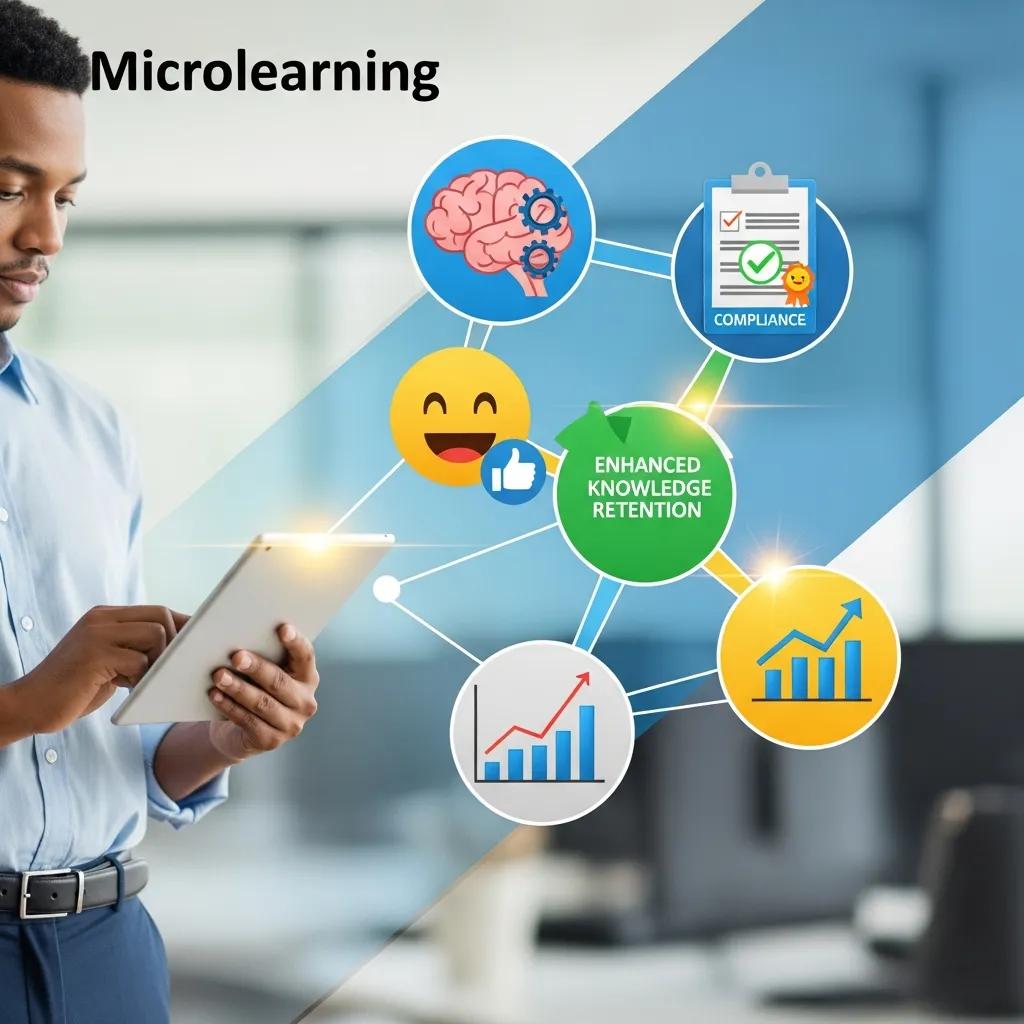
Microlearning delivers measurable improvements in retention, engagement, completion rates, and compliance tracking when designed and delivered correctly. It reduces barriers to participation by minimizing time away from work and increases relevance through contextually triggered content. For compliance programs, modular content simplifies audit trails and enables rapid targeted re-certification. Together, these outcomes help organizations reduce training costs while improving regulatory adherence and learner satisfaction.
How Does Microlearning Improve Knowledge Retention and Learner Engagement?
Microlearning improves retention by applying spaced repetition and retrieval practice in short, repeatable units that strengthen memory traces. Learners prefer bite-sized formats on mobile devices, which increases completion rates and reduces drop-off compared with hour-long courses. Interactive elements — such as micro-quizzes and scenario-based prompts — further boost engagement and encode knowledge through active recall. These design choices translate to measurable lifts in post-training scores and on-the-job performance metrics over time.
How Can Microlearning Streamline Compliance and Certification Training?
Micro-modules can be sequenced to mirror regulatory topic lists, enabling learners to complete targeted items that map directly to compliance requirements. This modular approach allows rapid refreshers for re-certification, and LMS reporting can produce clear audit trails for each module completed. Microlearning reduces time-to-completion for mandatory training while preserving proof of competency through short assessments. The approach also enables targeted remediation for learners who fail checks, cutting administrative overhead and compliance risk.
Introductory table summarizing measurable benefits appears below to clarify expected outcomes and example benchmarks for corporate L&D programs.
| Outcome Area | Measured Improvement | Typical Benchmark |
|---|---|---|
| Knowledge Retention | Retention lift via spaced micropractice | +10–30% on post-assessments |
| Completion Rate | Higher uptake for shorter modules | >80% completion for 3–10 min modules |
| Time-to-Competency | Faster onboarding and task proficiency | 20–40% reduction in ramp time |
| Compliance Tracking | Granular audit trails per topic | Per-module certification records |
These benefit metrics illustrate how microlearning aligns learning outcomes with business needs. When organizations target these outcomes deliberately, microlearning becomes a strategic tool for measurable L&D impact.
How Can Your LMS Integrate and Support Microlearning in the Flow of Work?
An LMS must prioritize mobile-first delivery, microcontent support, analytics (xAPI/SCORM/cmi5), and integration capabilities (APIs, LRS, webhooks) to enable microlearning at scale. These features let learning systems deliver content into workflows, capture detailed learning records, and trigger nudges from business applications. Security and certification workflows are also critical for regulated industries that require auditable completions and recurring validations. Together, those capabilities let teams orchestrate just-in-time learning while collecting the data needed to prove impact.
What LMS Features Are Essential for Delivering Bite-Sized Training?
Essential LMS features include responsive mobile UIs, microcontent authoring support, push notifications, granular analytics, and open APIs for integrations. Mobile-first interfaces ensure learners can access short modules during work moments without switching contexts. Authoring support for content chunking and micro-assessments enables rapid development and reuse of assets. Analytics and LRS support capture rich interaction data to measure engagement, retention, and competency progression.
The integration of Learning Management Systems (LMS) is a critical aspect of effective e-learning management.
LMS and E-Learning Management: An Integrative Review and Research Agenda
Information Technology (IT) can be an important component for innovation as enables e-learning and it can provide conditions for an organization to be able to work with new businesses and improved processes. In this regard, Learning Management Systems (LMS) allow communication and interaction between teachers and students in virtual spaces. However, the literature indicates that there are gaps in research, especially concerning the use of IT for the management of e-learning. The purpose of this paper is to analyze the available literature about the application of LMS for the e-learning management, seeking to present possibilities for research in the field. An integrative literature review was performed considering the Web of Science, Scopus, Ebsco and Scielo databases, where 78 references were found, of which 25 were full papers. By eliminating duplication, 14 papers remained, which came to constitute the portfolio of the study. The analysis of the papers allowed to conc
Learning Management Systems (LMS) and e-learning management: an integrative review and research agenda, PC Oliveira, 2016
How Do Totara and Moodle LMS Platforms Excel in Microlearning Delivery?
Totara and Moodle provide flexible architectures and plugin ecosystems that make them well-suited for microlearning and LIFOW deployments. Totara offers customizable workflows and competency frameworks that map micro-modules to onboarding and certification paths, while Moodle’s ecosystem supports diverse authoring tools and mobile apps for quick access. This site helps organizations streamline training, meet compliance, and scale learning with Totara and Moodle, offering expert-backed LMS solutions for onboarding, certification, and employee retention.
The continuous use of LMS platforms, especially in blended learning environments, is an area of ongoing research and development.
The Role of E-Engagement and Flow on LMS Continuance in Blended Learning
Learning management systems (LMS) provide an important delivery channel that overcomes the constraints of space and time in traditional face-to-face learning (Schophuizen et al.,2018; Zhao et al.,2020). Currently, there are many learning management systems, for example, WebCT, Moodle, OLAT, and Sakai. Despite their technological and pedagogical affordances, sustaining students’ continuous use of LMS remains challenging in both the online and blended learning environment (Ashrafi et al.,2020; Choudhury & Pattnaik,2020; Rasheed et al.,2020). According to Rasheed et al. (2020) there is a gap in understanding of the online component of blended learning and the issues facing students that prevent the con
The role of e-engagement and flow on the continuance with a learning management system in a blended learning environment, TT Goh, 2021
Introductory mapping table below links core LMS features to microlearning capabilities and shows how each supports on-the-job learning.
| LMS Capability | Capability Description | How It Supports Microlearning |
|---|---|---|
| Mobile Delivery | Responsive UI and apps | Enables access during tasks and on the go |
| Microcontent Authoring | Chunking, templates | Speeds development of 3–10 min modules |
| Analytics & LRS | xAPI/cmi5 support | Tracks detailed interactions and mastery |
| APIs & Integrations | Webhooks, REST APIs | Triggers learning from business systems |
| Certification Workflows | Competency frameworks | Sequences micro-modules into certs |
This mapping clarifies which LMS functions unlock microlearning use cases and how they integrate with business workflows. Prioritizing these features reduces implementation friction and accelerates adoption.
This site helps organizations streamline training, meet compliance, and scale learning with Totara and Moodle, offering expert-backed LMS solutions for onboarding, certification, and learner engagement.
How Do You Design and Implement an Effective Bite-Sized Learning Strategy?

Design begins by defining discrete objectives, mapping micro-units to workflow triggers, and establishing rapid authoring and governance processes. Implementation follows phased rollout: prioritize high-impact workflows, pilot micro-modules, collect analytics, and iterate based on performance signals. Change management focuses on embedding triggers, communicating cadence, and aligning managers with learning goals. The combination of clear objectives and iterative measurement delivers scalable microlearning that aligns with business outcomes.
What Are Best Practices for Developing Engaging Microlearning Content?
Effective microlearning centers on one objective per module, concise narrative, and immediate practice opportunity to reinforce learning. Use microvideos under two minutes, scenario-based questions, and quick knowledge checks to promote retrieval practice and relevance. Templates and style guides accelerate production while ensuring consistency and quality across modules. Continual iteration based on analytics ensures content remains current and aligned with learner needs.
- Introduction: The list below highlights tactical best practices for creating microlearning that sticks. Keep each module focused on a single, measurable objective to avoid cognitive overload. Use short multimedia (microvideo, animated steps) paired with a micro-assessment for retrieval practice. Provide job aids and templates that learners can download and apply immediately. Build reusable content blocks to assemble modular learning paths efficiently.
These practices make microlearning scalable and effective by emphasizing reuse, assessment, and performance support.
How Can Microlearning Be Seamlessly Integrated into Daily Workflows?
Integration requires defining triggers, selecting delivery channels, and designing cadence to match work rhythms and error-prone tasks. Triggers might include CRM alerts, ticketing events, performance coaching moments, or manager prompts that push a micro-module. Use APIs and LRS events to link business systems with the LMS so content appears contextually and data flows back for analytics. Ongoing measurement lets teams refine timing, reduce friction, and align learning with operational goals.
For teams seeking external support with design and rollout, this site helps organizations streamline training, meet compliance, and scale learning with Totara and Moodle, offering expert-backed LMS solutions for onboarding, certification, and learner engagement.
How Can Organizations Measure the Impact and ROI of Microlearning in the Flow of Work?
Measuring microlearning requires a mix of learning and business KPIs, instrumented through the LMS and learning record stores. Combine completion and pass rates with retention checks, time-to-competency, and behavior-change indicators tied to operational metrics. Use pre/post assessments, spaced retrieval probes, and on-the-job performance observations to triangulate learning impact. Translating those signals into productivity, error-reduction, or compliance risk metrics builds a business case for continued investment in employee retention.
What Key Performance Indicators Track Microlearning Success?
Track a balanced set of KPIs that capture engagement, learning, and business impact for a full picture of value. Examples include completion rate, micro-assessment pass rate, retention lift (via spaced tests), time-to-competency, and operational metrics such as error rates or task throughput. Benchmarks vary by context, but aiming for high completion and measurable retention gains gives early validation. Use xAPI data to correlate module interactions with downstream performance signals for stronger causal claims.
| KPI | Measurement Method | Suggested Benchmark |
|---|---|---|
| Completion Rate | LMS completion logs | >80% for 3–10 min modules |
| Retention Lift | Pre/post or spaced tests | +10–30% improvement |
| Time-to-Competency | Role assessments/time tracking | 20–40% reduction |
| Compliance Pass Rate | Module-level assessments | >95% pass/compliance rate |
| Behavior Change | Task error rates or supervisor ratings | 10–25% reduction in errors |
This KPI set links learning activity to business outcomes and provides pragmatic targets for pilots and scale-up phases. Regularly recalibrate benchmarks based on role complexity and organizational goals.
How Does AI Personalize and Enhance Microlearning Outcomes in LMS Platforms?
AI enhances microlearning by recommending modules, sequencing content adaptively, and personalizing assessment difficulty based on prior interactions. Recommendation engines can surface just-in-time modules tied to competency gaps, while adaptive quizzes adjust challenge to maintain optimal retrieval practice. In open LMS platforms, AI can be integrated via plugins or external services that feed personalized learning paths back into the LMS. Privacy and governance around learner data are essential; ensure models are transparent and metrics validated to maintain trust.
What Are the Future Trends and Innovations in Microlearning and LMS Solutions?
Microlearning and LMS capabilities will evolve with AI-driven authoring, deeper xAPI adoption, and richer integrations that place learning directly inside business applications. Expect built-in recommendation engines, micro-certifications, and improved mobile SDKs that reduce friction for in-task learning. Analytics will move beyond completion to measure competency networks and long-term performance outcomes. These innovations will make LIFOW more proactive, predictive, and tightly aligned with organizational goals.
How Is AI Transforming Personalized Microlearning Experiences?
AI is transforming personalization through automated content tagging, microcontent generation, and competency-based sequencing that matches modules to learner needs. Natural language processing enables rapid indexing of content for better recommendations, while adaptive assessment algorithms modulate difficulty to optimize learning curves. These advances can increase relevance and efficacy when paired with governance frameworks that ensure quality and privacy. Adoption will accelerate as organizations standardize data models and measure uplift from AI-driven personalization.
What Emerging LMS Features Will Shape Bite-Sized Training in 2025 and Beyond?
Emerging features include native AI recommendation engines, deeper xAPI and cmi5 support, enhanced mobile SDKs, and built-in micro-certification workflows that validate competencies in smaller increments. Stronger API ecosystems will enable instantaneous triggers from business systems to push contextually relevant microcontent. Advanced analytics will provide longitudinal views of competency networks and business impact, supporting strategic L&D decisions. Together, these features will make microlearning more measurable, integrated, and scalable for complex enterprises.
Microlearning delivers fast, on-the-job skill gains when it’s tied to real work triggers and tracked in your LMS.
Book a free demo or needs assessment with our experts to launch (or optimize) microlearning in Totara or Moodle.