
Closing Skill Gaps: Using LMS Skill Mapping Solutions for Effective Workforce Upskilling
Organizations that fall short on critical competencies face measurable drops in productivity, compliance risk, and slower time-to-proficiency for new hires. This article explains how LMS skill mapping turns assessment data and competency frameworks into actionable learning pathways that close those gaps, accelerate onboarding, and support certification workflows. You will learn how to identify skill gaps, how LMS-driven mapping and personalized learning paths function, which Totara and Moodle capabilities support competency management, and practical implementation steps for compliance, onboarding, and learner engagement. The guide also examines advanced trends—AI-driven gap analysis and predictive learning analytics—and provides KPI-focused measurement approaches to quantify ROI and sustain continuous improvement. By the end you will have a step-by-step checklist, platform feature comparisons, and measurement templates to design a scalable upskilling program using LMS skill mapping.
What Are Skill Gaps and Why Is Closing Them Critical for Workforce Development?
Skill gaps are the differences between the competencies employees currently have and the competencies required for business goals, and they matter because they directly reduce operational effectiveness. Organizations experience lower productivity, greater error rates, and increased compliance exposure when role expectations are not matched by staff capabilities. Closing skill gaps improves time-to-competency, strengthens retention, and enables teams to meet regulatory obligations with verifiable evidence. Recent workforce studies indicate that targeted upskilling programs can shorten ramp-up times and improve engagement, making proactive skill development a strategic priority for L&D and HR leaders. The next subsection examines practical methods to identify these gaps using assessments, analytics, and manager input.
How Do You Identify Skill Gaps in the Workplace?
Identifying skill gaps begins with a structured audit that combines assessments, performance data, and manager evaluations to create a single skills baseline. Start with a skills catalog mapped to role profiles, then run proficiency assessments—self, peer, and manager-rated—and compare results to required competency levels stored in HRIS or performance systems. LMS analytics (assessment items, course completions, competency reports) provide measurable signals, while manager feedback and operational KPIs validate performance shortfalls. Use quick diagnostic questions to prioritize gaps: which gaps block core workflows, which are regulatory, and which affect customer outcomes. After collecting evidence, validate findings through targeted observation or short practical tasks before assigning remediation learning.
What Are the Benefits of Closing Skill Gaps with LMS Skill Mapping?

Using LMS-driven skill mapping delivers measurable improvements compared with ad-hoc training because it links skills to roles, assessments, and formal learning paths that track progress. Organizations see faster time-to-productivity, clearer audit trails for compliance, and higher learner engagement through personalized content. Mapping skills inside an LMS enables targeted certification and automated recertification schedules, reducing manual administration and audit risk. The result is a repeatable, scalable approach to workforce development that aligns learning investment with business outcomes and reduces wasted training spend.
Intro to the benefits table: The following table summarizes key outcome categories, their primary impact on the organization, and example benchmark values to illustrate potential gains from closing skill gaps.
| Outcome | Impact | Example Benchmark |
|---|---|---|
| Employee retention | Increased engagement and reduced churn | 15–30% reduction in turnover in targeted cohorts |
| Time-to-competency | Faster role readiness | 20–40% faster ramp-up for new hires |
| Compliance assurance | Reduced audit findings and faster reporting | 95%+ on-time completion for mandated training |
| Productivity | Higher throughput and fewer errors | 10–25% improvement in role-specific KPIs |
This comparison highlights how alignment between competencies and learning interventions drives measurable business improvements and creates a basis for ROI calculation.
How Does LMS Skill Mapping Support Workforce Upskilling and Employee Skill Development?
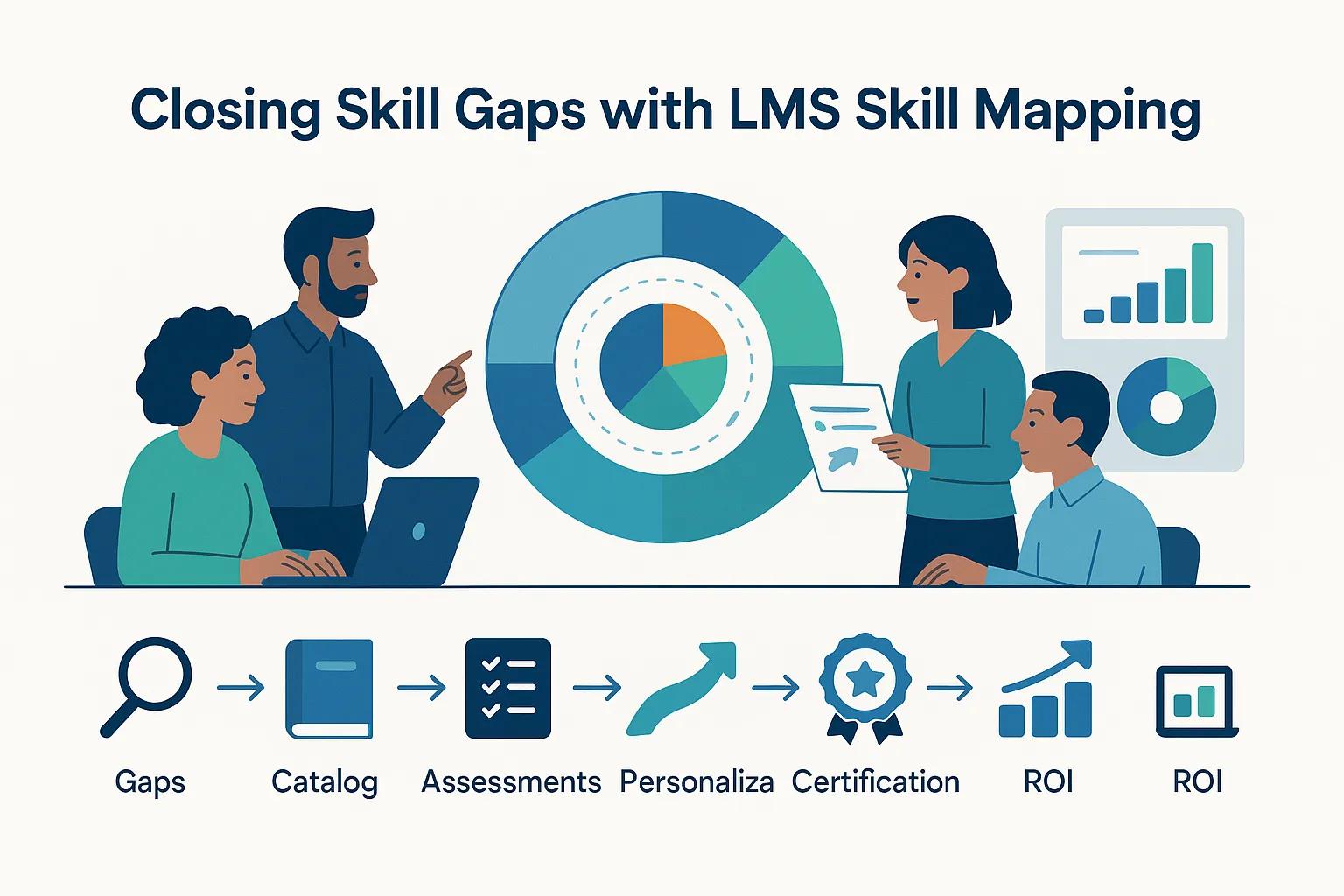
LMS skill mapping operationalizes upskilling by linking a centralized skill catalog to role profiles, assessments, and automated learning assignments, producing measurable proficiency gains. The mechanism is straightforward: define competencies, measure current proficiency, then assign personalized learning paths that close the delta while tracking evidence and credentialing. This closed-loop approach supports reskilling when roles evolve and upskilling for new capabilities, and it feeds analytics that inform program adjustments. The following subsections define LMS skill mapping in practical terms and explain how personalization boosts learning efficiency.
What Is LMS Skill Mapping and How Does It Work?
LMS skill mapping is the process of cataloging competencies, associating them with job roles, assessing employee proficiency, and automatically assigning learning pathways to address gaps. Core components include a searchable skill catalog, role profiles with required competency levels, assessment items (quizzes, assignments, observations), and a mapping engine that links assessment outcomes to learning modules or certification requirements. Data flows from HRIS and performance records into the LMS to ensure role definitions and progress are current, and the LMS captures evidence—badges, completion records, assessment scores—needed for audits and performance reviews. The output is measurable skill improvement and documented certification that managers can use in talent discussions.
How Do Personalized Learning Paths Enhance Upskilling and Reskilling?
Personalized learning paths increase relevance and speed learning by tailoring content to an individual’s assessed gaps rather than delivering the same curriculum to everyone. Approaches include pre-assessments to skip mastered content, branching scenarios that adapt based on responses, and microlearning modules focused on discrete competencies to reduce cognitive load. Personalization methods range from rules-based pathways to AI-driven recommendations that optimize sequence and pacing, improving completion rates and knowledge retention. Operationalizing personalization requires modular content design, tagging content to competencies, and continuous feedback loops to refine recommendations over time.
Technology-mediated learning platforms have become instrumental in addressing these efforts, as they can analyze platform data to provide personalized learning journeys.
Personalized Learning Paths: Technology-Mediated Upskilling
Technology-mediated learning platforms have become instrumental in addressing these efforts, as they can analyze platform data to provide personalized learning journeys. Such personalization is expected to increase
employees’ empowerment, job satisfaction, and learning outcomes.
What to Learn Next? Designing Personalized Learning Paths for Re-&Upskilling in Organizations, E Ritz, 2024
Which Features of Totara and Moodle Enable Effective Competency Management and Skill Development?
Totara and Moodle each provide foundational components—competency frameworks, learning pathways, assessments, and reporting—that support enterprise skill mapping, with different strengths around performance integration and workplace features. Totara offers enterprise-grade role-based learning and performance integrations ideal for competency management across large organizations, while Moodle’s extensible architecture and workplace modules provide adaptable assessment and certification workflows. Both platforms support APIs and plugins to integrate HR systems and external content libraries, enabling a connected talent ecosystem. The next paragraphs map platform modules to specific skill mapping use-cases and compare how each supports reporting and certification.
How Does Totara Learn Facilitate Skill Mapping and Competency Management?
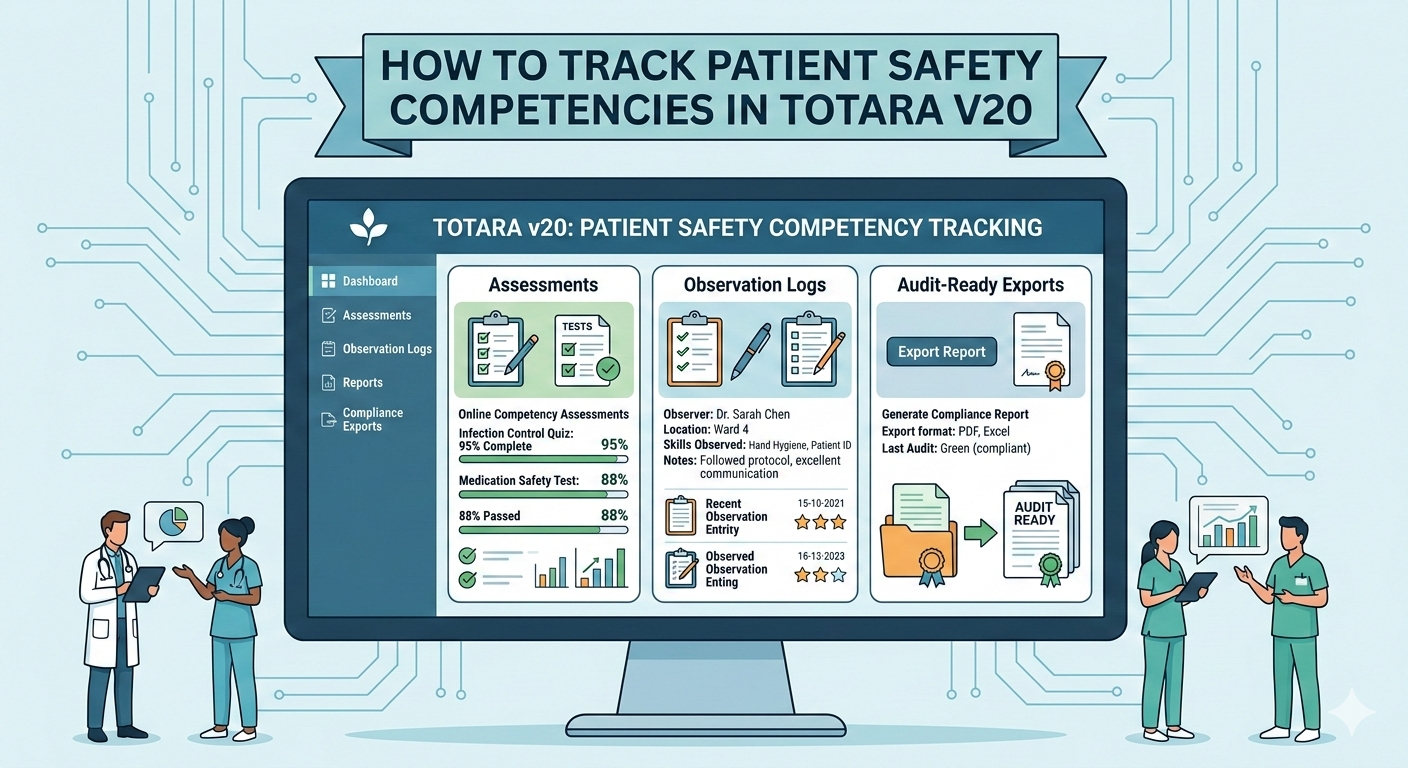
Totara’s architecture supports competency framework creation, role mapping, and learning pathways that align directly to performance objectives, enabling robust skill mapping across enterprise roles. Features like competency trees, learning plans, and configurable pathways let administrators define required proficiencies and link them to courses or resources that trigger automatically when gaps are detected. Totara Perform and engagement modules add performance review data that can update competency requirements and feed back into individualized learning plans, improving the tie between learning and on-the-job outcomes. Reporting tools provide audit-ready evidence for compliance and dashboards to monitor skill coverage across teams.
Intro to platform comparison table: The table below compares platform modules and features showing how each element supports practical skill mapping workflows.
| Platform / Module | Feature | How it supports skill mapping |
|---|---|---|
| Totara Learn | Competency frameworks & learning plans | Maps competencies to roles and automates targeted learning assignments |
| Totara Perform | Performance review integration | Aligns appraisal outcomes with development plans and updates skill profiles |
| Moodle Workplace | Role-based learning & multi-tenant paths | Enables job-specific pathways and scalable certification per business unit |
This side-by-side view clarifies which platform capabilities are best suited for competency lifecycle tasks and where integrations add value.
Following those feature mappings, organizations seeking implementation support can benefit from specialist expertise that configures these modules to business rules and governance needs. A practical implementation ties platform capabilities—competency frameworks, learning plans, and reporting—to onboarding and certification workflows while ensuring integrations with HR systems and performance data.
How Can Organizations Implement LMS Skill Mapping to Streamline Compliance, Onboarding, and Learner Engagement?
Effective implementation follows a phased approach: pilot a skill catalog and assessment process, validate mappings with managers, scale learning pathways, and govern outcomes through dashboards and audits. Governance defines roles for competency owners, data stewards, and learning architects; integrations feed HRIS and performance data into the LMS to maintain accuracy; and change management ensures managers understand how to use skill reports in development conversations. When implemented properly, skill mapping reduces manual compliance tracking, accelerates onboarding through role-based learning plans, and increases engagement via targeted, relevant content. This site helps organizations streamline training, meet compliance, and scale learning with Totara and Moodle, offering expert-backed LMS solutions for onboarding, certification, and learner engagement.
What Role Does LMS Play in Managing Compliance Training and Certification?
An LMS enforces compliance by assigning mandated courses, scheduling recertification, and capturing auditable evidence of completion that meets regulatory requirements. Automated workflows can trigger retraining when assessments indicate knowledge decay or when certification windows expire, while audit logs and exportable reports supply regulators with verifiable records. Best-practice KPIs for compliance include on-time completion rates, overdue counts, and evidence capture percentage, which should be monitored via dashboards and reviewed by compliance owners. Integrating certification workflows with HR records ensures that role changes automatically update required training lists, reducing administrative overhead and audit risk.
How Does LMS Skill Mapping Improve Onboarding and Learner Engagement?
Skill mapping transforms onboarding from a one-size-fits-all orientation into a staged ramp-up driven by role-specific milestones and learning checkpoints. New hires receive tailored learning plans focused on the exact competencies needed for their role, combined with microlearning modules and mentor pairing to support practical application. Engagement features—gamification, social learning forums, and progress badges—reinforce milestones and create visible evidence of development. Track metrics like time-to-productivity, onboarding completion rates, and learner satisfaction to measure impact and iterate on onboarding content and sequencing.
Intro to implementation checklist: The following numbered checklist outlines practical steps for rolling out LMS skill mapping from pilot to scale.
- Define a prioritized skill catalog tied to core role profiles.
- Establish governance roles: competency owners, data stewards, and learning architects.
- Pilot assessments and learning paths with a target cohort, then validate outcomes.
- Integrate HRIS and performance data to automate role updates and evidence capture.
- Scale pathways, enable automated certification, and monitor KPIs via dashboards.
- Iterate content and cadence based on learner feedback and performance data.
This checklist provides a sequenced roadmap to reduce risk during rollout and ensure the program delivers measurable value.
What Advanced Strategies and Future Trends Enhance LMS Skill Mapping for Workforce Upskilling?
Advanced strategies center on using AI and analytics to scale skill inference, personalize recommendations, and forecast future skill needs so organizations can be proactive rather than reactive. Predictive models applied to assessment and performance data identify roles at risk of skill decay and recommend microlearning to close gaps before business impact materializes. Emerging trends also include micro-credentials and modular pathways designed for rapid reskilling and integrating external labor market signals to prioritize curriculum updates. The next subsections examine AI capabilities and specific emerging skills that L&D teams should prepare for.
How Is AI Transforming Skill Gap Analysis and Personalized Learning in LMS Platforms?
AI augments skill mapping by automating skill inference from job descriptions, performance records, and assessment patterns, creating scalable profiles without manual tagging. Recommendation engines rank and sequence content based on predicted learning efficacy and prior outcomes, while adaptive assessments adjust difficulty to measure true proficiency. Benefits include faster personalization, higher recommendation relevance, and reduced administrative effort, but implementation requires strong data governance, attention to bias, and privacy safeguards. Practical AI workflows pair human review with model outputs to ensure accuracy and to refine recommendations over time.
What Are the Emerging Workforce Skills and How Can LMS Prepare Organizations?
Emerging skills—AI literacy, data analytics, digital collaboration, and sustainability-related competencies—are rising in demand across sectors and benefit from modular, competency-based curricula. Design curricula that combine foundational micro-modules, applied projects, and badges to demonstrate capability, and update learning paths quarterly or biannually based on market signals and internal performance trends. Using predictive analytics to surface priority skills enables L&D to sequence programs that preempt talent shortages. Regular review cycles and stakeholder input keep content aligned with evolving business needs.
How Do You Measure the Success and ROI of LMS-Based Skill Mapping and Upskilling Programs?
Measuring success requires a combination of proficiency-focused KPIs, operational metrics, and business outcomes that together demonstrate skill gap closure and value delivered. Primary measures include proficiency gains from pre/post assessments, time-to-competency improvements, completion and recertification rates, and retention or productivity changes linked to training interventions. Building dashboards that combine LMS analytics with HRIS and performance metrics creates a unified talent view that supports ROI calculations. The following table defines key KPIs, their definition, and example targets to guide measurement design.
Intro to KPI table: Use the table below to standardize KPI definitions and set sample targets for program evaluation.
| KPI | Definition | Example Target |
|---|---|---|
| Proficiency gain | Average increase in competency score after intervention | +20–40% over baseline |
| Time-to-competency | Days to reach role proficiency benchmark | Reduce by 20–30% |
| Completion rate | Percentage of assigned learning completed on time | ≥ 90% for mandatory paths |
| Retention lift | Improvement in retention for trained cohorts | +10–20% year-over-year |
These KPIs create a measurable framework linking learning activity to performance outcomes and informing continuous improvement cycles.
What Key Performance Indicators Track Skill Gap Closure and Upskilling Impact?
KPIs should be defined clearly, sourced from reliable systems, and benchmarked so stakeholders understand progress and investment value. Proficiency gain measures pre/post assessment improvements, while time-to-competency captures how quickly employees reach operational standards. Completion and recertification rates indicate process health for mandatory training, and retention or productivity metrics link learning to business outcomes. Use LMS analytics for activity and assessment data, HRIS for employment events, and performance systems for outcome measures to populate dashboards that support decision-making and ROI calculations.
What Best Practices Ensure Continuous Improvement in LMS Skill Mapping Initiatives?
Continuous improvement requires governance, scheduled competency audits, content lifecycle management, and feedback loops with learners and managers to keep the program relevant. Establish quarterly reviews for high-priority competencies and annual audits for broader catalogs, and assign clear ownership for updating learning modules and validating assessment items. Use learner feedback and outcome analytics to retire low-impact content and invest in modular assets that can be recombined for new pathways. Regularly communicate program impact to stakeholders using dashboards and success stories to sustain investment and adoption.
This site helps organizations streamline training, meet compliance, and scale learning with Totara and Moodle, offering expert-backed LMS solutions for onboarding, certification, and learner engagement.
- Implementation-ready guidance: The steps and KPI definitions in this guide provide a practical path from audit to measurable upskilling.
- Platform alignment: The feature mappings clarify where Totara and Moodle capabilities should be applied within your competency lifecycle.
- Continuous measurement: Use the KPI table and dashboards to iterate and demonstrate ROI over time.
These actions create a durable learning system that closes skill gaps while aligning L&D investment to business priorities.
Frequently Asked Questions
What are the common challenges organizations face when implementing LMS skill mapping?
Organizations often encounter several challenges when implementing LMS skill mapping. These include resistance to change from employees who may be accustomed to traditional training methods, difficulties in accurately assessing current skill levels, and the need for robust data governance to ensure the integrity of skill assessments. Additionally, aligning the skill mapping process with existing HR systems and ensuring that all stakeholders understand their roles can be complex. Overcoming these challenges requires clear communication, training, and a phased implementation approach to build buy-in and ensure success.
How can organizations ensure the effectiveness of their upskilling programs?
To ensure the effectiveness of upskilling programs, organizations should establish clear objectives aligned with business goals and regularly assess the impact of training initiatives. Utilizing feedback from participants and managers can help refine content and delivery methods. Additionally, tracking key performance indicators (KPIs) such as proficiency gains, completion rates, and employee retention can provide insights into program effectiveness. Continuous improvement through regular audits and updates to learning paths based on emerging skills and market trends is also essential for maintaining relevance and engagement.
What role does employee feedback play in the LMS skill mapping process?
Employee feedback is crucial in the LMS skill mapping process as it provides insights into the effectiveness of training programs and identifies areas for improvement. Gathering feedback through surveys, focus groups, or informal discussions allows organizations to understand learners’ experiences and challenges. This information can inform adjustments to learning paths, content delivery, and support mechanisms. By actively involving employees in the feedback loop, organizations can enhance engagement, ensure that training meets their needs, and foster a culture of continuous learning and development.
How can organizations leverage data analytics in their skill mapping efforts?
Organizations can leverage data analytics in skill mapping by analyzing performance data, assessment results, and learning engagement metrics to identify skill gaps and training needs. Predictive analytics can forecast future skill requirements based on industry trends and internal performance patterns, allowing organizations to proactively address potential gaps. Additionally, analytics can help measure the effectiveness of training interventions by tracking improvements in employee performance and productivity. By integrating data from various sources, organizations can create a comprehensive view of their workforce’s skills and tailor their upskilling strategies accordingly.
What are the best practices for maintaining an updated skill catalog?
Maintaining an updated skill catalog involves regular reviews and audits to ensure that competencies reflect current business needs and industry standards. Organizations should establish a governance framework that assigns ownership for updating the catalog and validating assessment criteria. Engaging with stakeholders, including managers and employees, can provide valuable insights into emerging skills and competencies. Additionally, leveraging market research and industry benchmarks can help keep the catalog relevant. Implementing a schedule for periodic updates, such as quarterly or biannually, ensures that the skill catalog evolves alongside organizational and market changes.
How can organizations measure the long-term impact of their upskilling initiatives?
To measure the long-term impact of upskilling initiatives, organizations should track a combination of qualitative and quantitative metrics over time. Key performance indicators (KPIs) such as employee retention rates, productivity improvements, and proficiency gains from pre- and post-assessments can provide insights into the effectiveness of training programs. Additionally, conducting regular employee satisfaction surveys can gauge the perceived value of upskilling efforts. Longitudinal studies that compare performance metrics before and after training interventions can also help demonstrate the sustained impact of upskilling initiatives on organizational success.