

LXP vs LMS: How to Choose Between a Learning Experience Platform and a Traditional Learning Management System
Learning leaders face a fundamental choice when modernizing workforce development: stick with a traditional learning management system (LMS) that enforces structure and auditability, adopt a learning experience platform (LXP) that prioritizes personalization and discovery, or blend both into a hybrid ecosystem. This article explains what an LMS is, what an LXP does, and why the distinction matters for outcomes such as compliance, time-to-competency, and learner engagement. You will learn core features, practical differences, decision criteria for choosing LMS, LXP, or hybrid approaches, and clear implementation patterns that reconcile regulatory needs with learner-centric design. The guide also maps how Totara and Moodle — established LMS cores — support compliance and how they can be extended with LXP-like personalization. Finally, we explore integration strategies, KPIs, and near-term trends (AI, machine learning) that decision-makers should weigh in 2025 when selecting an employee training platform. Read on for a structured decision framework and tactical steps you can use immediately.
What Is a Learning Management System and What Are Its Core Benefits?
A learning management system (LMS) is a structured software platform that manages, delivers, and records formal learning activities; it centralizes course creation, enrollment, assessment, and reporting so administrators can meet regulatory and organizational requirements. An LMS works by enforcing defined course pathways, tracking learner progress through enrollments and completions, and producing auditable logs that support compliance and certification workflows. Core benefits include reliable compliance reporting, consistent onboarding experiences, and formal certification management that reduces administrative risk. Understanding these core functions clarifies why regulated industries and certification programs continue to rely on LMS platforms even as richer learner experiences emerge. The next sections break down the specific LMS features that map directly to these benefits so organizations can match platform capabilities to operational needs.
What Features Define a Traditional LMS for Corporate Training?
A traditional LMS includes a set of administrative and learner-facing features designed for predictable, auditable training delivery. Course management lets authors create structured modules and assessments, while user and role management enables targeted enrollments and permissions tied to job roles. Reporting and analytics provide completion records, audit trails, and exportable certificates that satisfy external auditors and compliance teams. These features collectively make the LMS the authoritative source of truth for mandatory training and structured curricula, which is critical for industries where proof of training is required for legal or safety reasons. Clear role-based controls and versioned course artifacts further ensure that training remains consistent and defensible over time.
How Does an LMS Support Compliance, Onboarding, and Certification?
An LMS supports compliance by automating enrollment, scheduling periodic re-certifications, and recording completion evidence with timestamps and assessment results; these elements form the audit trail auditors expect. Onboarding workflows combine mandatory orientation courses, role-specific safety training, and HR data triggers so new hires progress through defined milestones automatically. Certification features issue credentials when learners meet assessment criteria and can enforce expiration and renewal sequences to keep skills current. Integration with HR systems and single sign-on preserves identity fidelity and streamlines administrative overhead, which reduces time-to-competency and minimizes compliance gaps across distributed teams.
What Is a Learning Experience Platform and How Does It Enhance Learner Engagement?
A learning experience platform (LXP) is a learner-centric platform that aggregates content from diverse sources, uses AI to personalize recommendations, and emphasizes discovery, social collaboration, and informal learning pathways. Mechanically, an LXP analyzes user behavior and skill profiles to surface playlists, microlearning, and user-generated content that match personal development goals. The result is higher engagement and faster skill acquisition for discretionary learning because employees discover relevant resources at the point of need. For organizations focused on upskilling and continuous development, an LXP complements structured programs by driving adoption through personalization and social learning mechanics.
What Are the Key Features of an LXP for Personalized Learning?
Introductory list: Key LXP differentiators and what they deliver.
- AI Recommendations: Automated, role-aware suggestions that prioritize high-impact microlearning.
- Content Aggregation: Unified access to courses, articles, videos, and third-party resources in one feed.
- Social and UGC: Peer-created content and collaboration that surface tacit knowledge quickly.
These LXP features together increase engagement and make informal learning measurable, setting the stage for hybrid approaches that map to formal competency goals.
What Are the Main Differences Between LXP and LMS Platforms?

LMS and LXP platforms differ fundamentally in control model, content scope, analytics focus, and governance: the LMS emphasizes administrator-driven, structured learning with compliance-grade reporting, while the LXP emphasizes learner-driven discovery, curated content, and social engagement. Practically, LMS content tends to be formal courses with assessments, while LXP content mixes curated external media, microlearning, and UGC. Analytics in an LMS focus on completion and certification, whereas LXP analytics emphasize engagement signals, content effectiveness, and skills growth trajectories. These distinctions guide decision-making: organizations should prioritize LMS for regulatory obligations and formal credentialing, and LXP for continuous development and engagement.
Introductory table: Quick side-by-side comparison for rapid decision scanning.
| Platform Type | Primary Driver | Typical Content Model |
|---|---|---|
| LMS | Administrator-driven governance | Structured courses, assessments, certifications |
| LXP | Learner-driven discovery | Curated microcontent, user-generated and third-party resources |
| Hybrid | Integrated governance + personalization | Formal courses plus personalized playlists and recommendations |
This comparison clarifies where each platform excels and why many organizations end up adopting hybrid models to balance control and engagement.
How Do LMS and LXP Differ in Learning Approach and Content Delivery?
An LMS enforces formal learning sequences with summative assessments and role-based enrollment, producing verifiable outcomes such as issued certificates and retraining schedules. An LXP delivers adaptive, often continuous learning experiences where learners self-select content or receive AI-curated suggestions tied to skill maps. For example, a compliance module in an LMS ensures standardized completion and a stamped certificate, while an LXP would present related micro-lessons, case studies, and peer discussions to deepen applied understanding. The pedagogical contrast—formal assessment versus social discovery—determines how content is authored, governed, and measured across both systems.
When Should Organizations Choose LMS, LXP, or a Hybrid Solution?
Deciding which architecture to adopt depends on three practical criteria: regulatory exposure, scale of continuous development needs, and learner engagement objectives. If regulatory compliance, auditability, and certification are mandatory, choose an LMS-first approach that ensures governance and reporting. If rapid upskilling, employee retention, and engagement are primary goals, incorporate an LXP or LXP-like layer to drive discovery and informal learning. When both sets of goals matter—common in larger enterprises—implement a hybrid ecosystem where the LMS remains the authoritative record and the LXP provides personalized front-end experiences.
Decision checklist for platform selection:
- Compliance requirement? Choose LMS-first and map mandatory courses into governed curricula.
- High need for continuous upskilling? Add LXP capabilities for personalization and microlearning.
- Both compliance and engagement matter? Implement a hybrid model with integrated data and identity.
This checklist helps learning leaders translate strategic priorities into an architecture that balances governance with learner experience.
How Do Totara and Moodle LMS Solutions Address Compliance, Certification, and Engagement?
Totara and Moodle are mature LMS cores widely used in corporate contexts to manage onboarding, certification, and compliance training; both provide reporting, role-based access, and extensibility to meet enterprise requirements. Totara often emphasizes workplace learning features and multi-tenant capabilities that fit complex organizational hierarchies, while Moodle’s plugin ecosystem enables tailored course formats and assessment types. Both platforms produce auditable completion records, support automated re-certification workflows, and integrate with HR/identity systems to streamline enrollments. For organizations that need both regulatory assurance and improved engagement, Totara and Moodle can serve as the structured foundation that is extended with personalization and curation layers.
Introductory table: How Totara and Moodle map to compliance, certification, and extensibility.
| Platform | Compliance & Reporting | Certification & Renewal | Extensibility & Use Cases |
|---|---|---|---|
| Totara | Robust reporting and multi-tenant audit trails | Automated certification workflows and role-based renewals | Plugin modules, enterprise features for onboarding and compliance |
| Moodle | Detailed logs and exportable completion records | Modular certificate plugins and scheduled re-certification | Large plugin ecosystem for varied corporate training uses |
| LMS Core (General) | Centralized user management | Credential issuance and expiry controls | API integrations and custom front-ends |
This table shows how each platform aligns with auditability and where LXP-like features are typically added through extensions or integrations.
What Compliance and Certification Features Do Totara and Moodle Offer?
Both Totara and Moodle support compliance needs through detailed activity logs, exportable reports, and configurable role-based access controls that preserve proof of training. Certification workflows in these LMS cores can issue digital credentials on successful assessment completion and trigger re-certification schedules to enforce ongoing competency. Extensibility allows organizations to add third-party reporting tools or business intelligence connectors for centralized auditing across multiple systems. These capabilities make Totara and Moodle practical choices for organizations prioritizing legal and operational compliance while retaining options to evolve learner experiences.
How Can Totara and Moodle Integrate LXP-Like Features for Enhanced Learning?
Tactical approaches to add LXP capabilities to Totara or Moodle include deploying recommendation engines via middleware, enabling content curation through integrated content repositories, and surface social features using plugins or front-end layers that connect to the LMS core via APIs. A common pattern is to keep the LMS as the authoritative record while exposing a personalized LXP-style front end that reads and writes completion data back to the LMS. This pattern maintains auditability while delivering AI-powered recommendations, curated playlists, and social interactions that boost engagement. The next section lays out integration patterns and KPIs to measure hybrid success.
What Are the Benefits and Strategies for Integrating LMS and LXP Platforms?
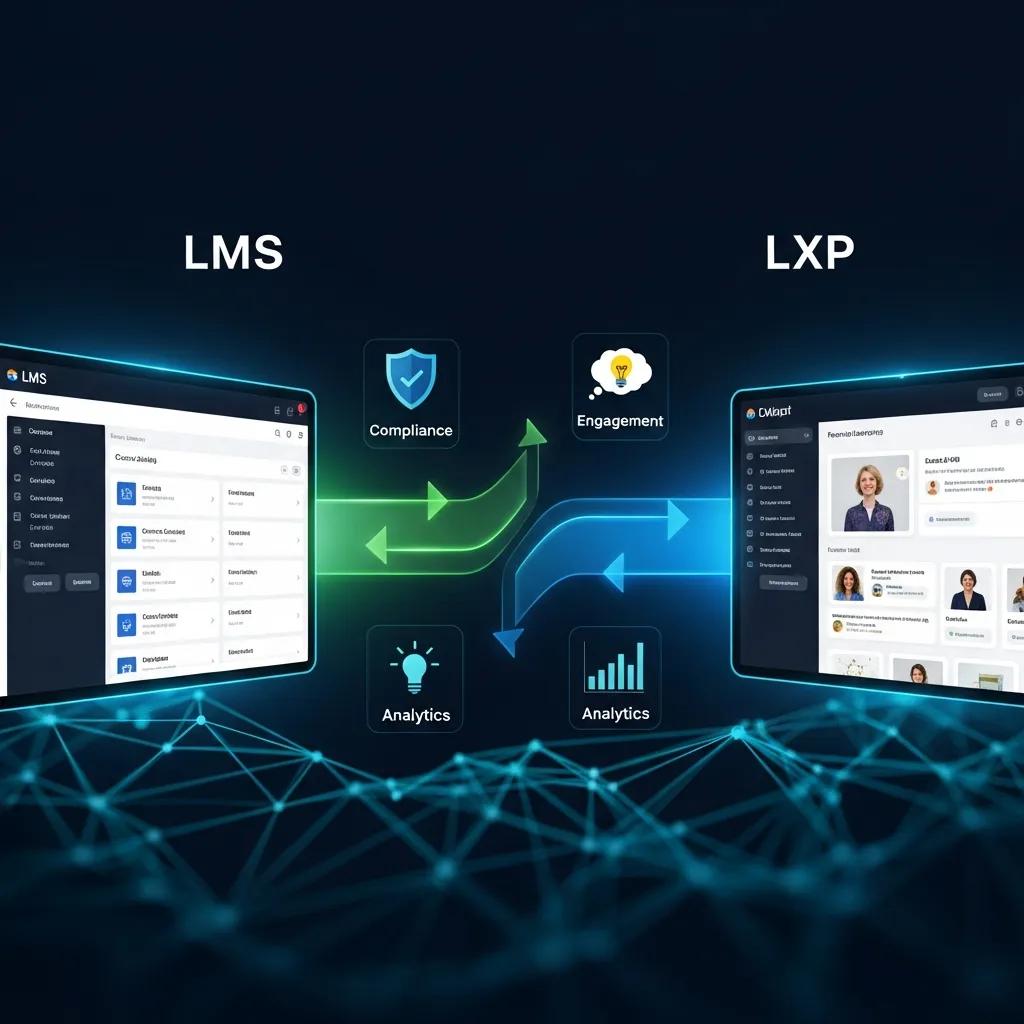
Integrating an LMS core with LXP-like capabilities delivers the combined benefits of compliance, measurable skill development, and higher learner engagement, which together shorten time-to-competency and increase program adoption. Integration patterns vary from lightweight SSO and content syndication to fully orchestrated API-based middleware that synchronizes user profiles, learning records, and skill taxonomies. Common KPIs to monitor include completion rates for mandatory courses, engagement metrics for curated playlists, and time-to-competency for role-based skills. Implementation should be phased: assess objectives, pilot a limited integration, collect KPIs, iterate on content and taxonomy, then scale.
Introductory table: Integration patterns and measurable outcomes for hybrid learning ecosystems.
| Integration Pattern | Primary Benefit | KPI to Track |
|---|---|---|
| LMS core + LXP front-end | Auditability with personalized UX | Adoption rate of curated playlists |
| API orchestration & data sync | Unified learner profile & analytics | Reduction in time-to-competency |
| Plugin-based extensions | Fast deployment of features | Completion rates for mandatory training |
This table clarifies which patterns yield specific business outcomes and which metrics will show success after integration.
How Does a Hybrid Learning Ecosystem Improve Corporate Training Outcomes?
A hybrid ecosystem pairs the LMS’s authoritative tracking with the LXP’s discovery-driven experience, yielding measurable gains: higher voluntary engagement, better alignment of learning to skill gaps, and improved retention of applied skills. Hypothetical outcomes from pilots show adoption increases when personalized playlists are surfaced alongside mandatory courses, and re-certification compliance remains intact because the LMS still records formal completions. Analytics that merge engagement signals with completion records enable L&D to iterate on content mix and demonstrate ROI through improved competency scores and reduced onboarding time. Establishing these measurement loops turns hybrid platforms into continuously improving learning systems.
What Are Best Practices for Implementing LMS-LXP Integration?
Practical steps start with defining clear objectives and measurable KPIs, then mapping data flows and identity management requirements (SSO, user provisioning) before any technical work begins. Pilot a single business unit or use case, instrument analytics to track both compliance and engagement metrics, and use governance boards to manage taxonomy and content ownership. Ensure data governance policies cover privacy and retention, and phase integration to allow iterative improvements to recommendation algorithms and content curation. These practices reduce risk, accelerate adoption, and create a repeatable playbook for scale.
Introductory list: Best-practice checklist for hybrid implementations.
- Define business outcomes: Establish KPIs such as completion rate, engagement, and time-to-competency.
- Pilot early and measure: Start with a bounded use case and instrument analytics for both compliance and informal learning.
- Govern taxonomy and data: Align skill taxonomies and secure learner data governance before scaling.
Following these steps creates a controlled path from pilot to enterprise rollout that balances governance with learner experience.
What Are the Future Trends in Learning Platforms: AI, Machine Learning, and Personalized Learning Paths?
AI and machine learning are accelerating the convergence between LMS and LXP capabilities by enabling scalable personalization, automated tagging, and predictive skills insights that inform both formal and informal learning programs. Recent research and vendor roadmaps in 2023–2024 emphasize recommendation engines that infer skills from work activities, automated content enrichment that reduces manual curation, and analytics that predict competency gaps. Adopting these technologies requires attention to data quality, model governance, and privacy; when implemented correctly, AI transforms raw engagement signals into actionable learning pathways that feed the LMS record. The following subsections explain concrete AI use-cases and market signals that should influence platform choices.
How Are AI and Machine Learning Transforming LMS and LXP Capabilities?
AI powers recommendation engines that map user behavior to skill taxonomies, enabling personalized playlists that adapt as learners progress; machine learning also automates content tagging and relevance scoring to reduce curator workload. Skills inference models can correlate on-the-job indicators with learning activity to surface high-impact interventions before performance issues emerge. Automated analytics produce insights into learning efficacy, highlighting which content correlates with competency gains. These capabilities make it practical to operationalize continuous learning while preserving the LMS as the single source of record for formal achievements.
What Market Trends Should Organizations Consider When Choosing Learning Platforms?
Organizations should weigh three trends when selecting platforms: growing preference for hybrid architectures, increasing vendor emphasis on AI-driven personalization, and rising demand for measurable business outcomes such as reduced onboarding time and improved compliance percentages. Adoption data shows enterprises increasingly favor solutions that can interoperate via APIs and that support identity/data federation. Recommended metrics to monitor during selection and rollout include completion and certification compliance, engagement with curated content, and measurable changes in performance or time-to-competency. These signals will validate platform ROI and inform iterative improvements.
For organizations seeking expert support, remember that the right implementation balances governance and personalization: Totara and Moodle can serve as the structured LMS core while integrations and front-end layers supply LXP-like discovery and engagement. The company described in this guide focuses on helping organizations streamline training, meet compliance, and scale learning, delivering expert-backed LMS solutions using Totara and Moodle for onboarding, certification, and learner engagement. If your primary goals include compliance training, scalable certification management, or improved onboarding adoption, consider engaging expert-backed Totara/Moodle assessments or demos to align platform choices with measurable KPIs and phased integration plans.
Conclusion
Choosing between a Learning Management System (LMS) and a Learning Experience Platform (LXP) is crucial for optimizing workforce development and learner engagement. Each platform offers distinct advantages: LMS ensures compliance and structured training, while LXP enhances personalization and discovery. By understanding these differences, organizations can make informed decisions that align with their training goals and regulatory needs. Explore our experts-backed solutions to find the right platform for your organization’s unique learning requirement book a demo today !