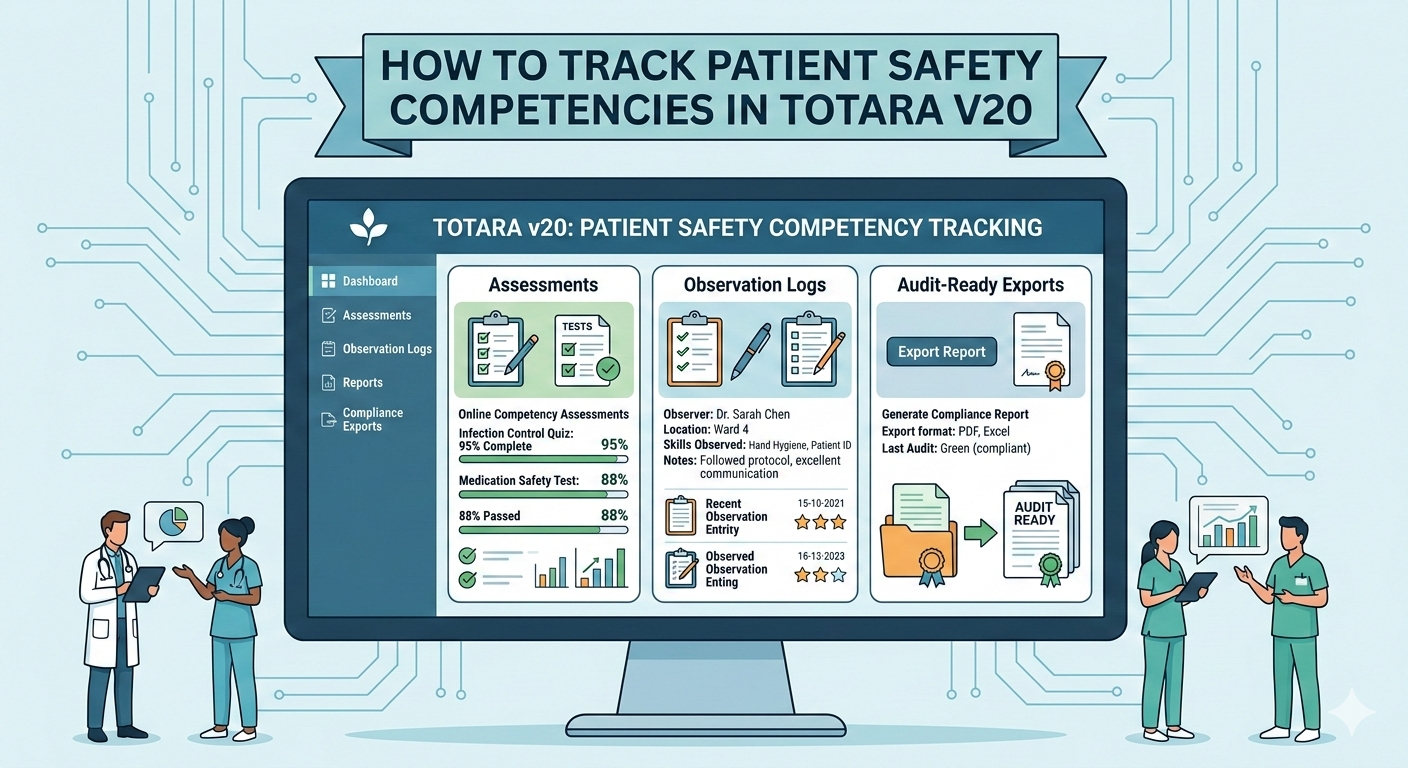
Keeping patient safety competencies visible and up to date is essential for healthcare teams that want to improve care quality and meet regulatory expectations. This article explains how Totara v20 helps you manage those competencies using assessments, observation logs, and exports built for audits. You’ll get a clear view of the competency frameworks you can map in Totara, how to build and run clinical skills assessments, ways to use observation logs for real‑time tracking, and how to produce compliance reports. Armed with these practices, clinical leaders and educators can tighten their competency workflows and demonstrate safer care.
Putting a strong learning and tracking framework in place makes continuous improvement and patient safety practical, repeatable, and measurable.
Patient Safety Learning Management Framework
A culture that learns, is transparent, and consistently seeks improvement is central to reducing harm and raising care standards. Too often, learning in healthcare has been limited to isolated efforts; systems need scalable, organisation‑wide learning approaches. This paper outlines a learning management framework implemented across a multistate health system that also operates as a patient safety organization (PSO), helping the system move toward high reliability.
Building a Learning Management Framework for Patient Safety: Lessons From a Large Multistate System, 2024
Patient safety competencies are the skills, knowledge, and behaviours clinicians need to deliver safe care and reduce risk. Totara v20 supports competency management by providing an LMS that ties learning plans to assessments, evidence, and tracking tools. With Totara V20 you can monitor who has the required skills, measure learning effectiveness, and close gaps that put patients at risk.
The link between staff competence and a strong patient safety culture is direct and measurable.
Nurse Competence & Patient Safety Compliance
Poor or inconsistent practice contributes to avoidable harm. Competent nurses are a foundation of safe, high‑quality care not just technically, but in how safety values are lived day to day. A safety culture depends on shared beliefs and behaviours that translate into safer clinical practice. High competence levels support that culture and help organizations meet their safety goals.
Clinical nurse competence and its effect on patient safety culture: a systematic review, NB Said, 2023
Totara v20 doesn’t ship with specific named frameworks preloaded (for example, National Patient Safety Goals or Joint Commission checklists). Instead, it’s built to be configured you map competencies, courses, and assessments to whatever framework your organization follows. That flexibility lets teams align learning plans and reporting to local standards, national guidance, or accreditation requirements.
Building clinical skills assessments in Totara follows a few practical steps: define the competencies and observable behaviours, design assessment tasks that mirror real practice, and set up the assessment activity within Totara. Use rubrics or checklists for consistent scoring, and schedule periodic reassessments to keep evidence current.
Totara also streamlines administration, automated reminders, progress tracking, and learner histories, helping maintain compliance and showing development over time.
Different assessment formats serve different purposes. Common effective types include:
Combining methods gives a fuller picture of competence than any single approach.
Observation logs let supervisors and peers record observed practice as it happens, producing timely, actionable evidence of competence. In Totara v20 you can create customizable log templates tied to specific competencies so observations feed directly into a learner’s record.
Observation logs are structured records of clinical interactions or skill demonstrations. They strengthen monitoring by documenting real behaviour, highlighting improvement needs, and supporting coaching conversations. When integrated into competency records, logs make performance trends visible and support a continuous improvement loop.
Audit‑ready reports in Totara are produced by aggregating assessment outcomes, observation entries, and course completions into exportable formats. These reports provide the traceable evidence regulators and internal reviewers expect and can be filtered by learner, team, competency, or date range for targeted reviews.
Using an LMS strategically helps organizations meet regulatory demands with clear, defensible records of training and competence.
LMS for Compliance in Regulated Industries
This example highlights how an LMS can simplify training administration and, importantly, provide documented evidence of compliance for regulators in highly regulated sectors.
Compliance: a convincing case for learning management systems, 2005
Totara v20 can export data in common formats CSV, PDF, Excel—making it straightforward to share reports with auditors and stakeholders. While Totara provides features to support data security and privacy, aligning the platform with standards like HIPAA or ISO 9001 is the responsibility of the organization’s implementation and governance. Totara is the tool; compliance depends on how you configure and operate it.
To keep competency programs effective and audit‑ready, adopt these practices:
Linking assessments and observation logs gives a complete audit trail. Make sure each observation and assessment entry references the relevant competency and learner record. That linkage creates a coherent narrative of performance and development that supports both learning and compliance reviews.
Monitoring competency tracking means routinely reviewing assessment outcomes, observation trends, and completion data to identify gaps or drift. Establish regular review cycles, assign ownership for updates, and use feedback from learners and supervisors to refine assessments and learning content.
Useful tools and KPIs include:
Together, these metrics help you confirm that competency tracking supports safer care and delivers measurable improvement.
Systematic competency tracking is a practical way to raise care quality and prove compliance. Totara v20 offers the building blocks, assessments, observation logs, and exportable reports to create a dependable competency management program. When configured thoughtfully and paired with regular review, these tools help teams embed safer practices and demonstrate continuous improvement. Explore how tailored Totara solutions can support your competency tracking and compliance goals. Book a customized demo with us today.